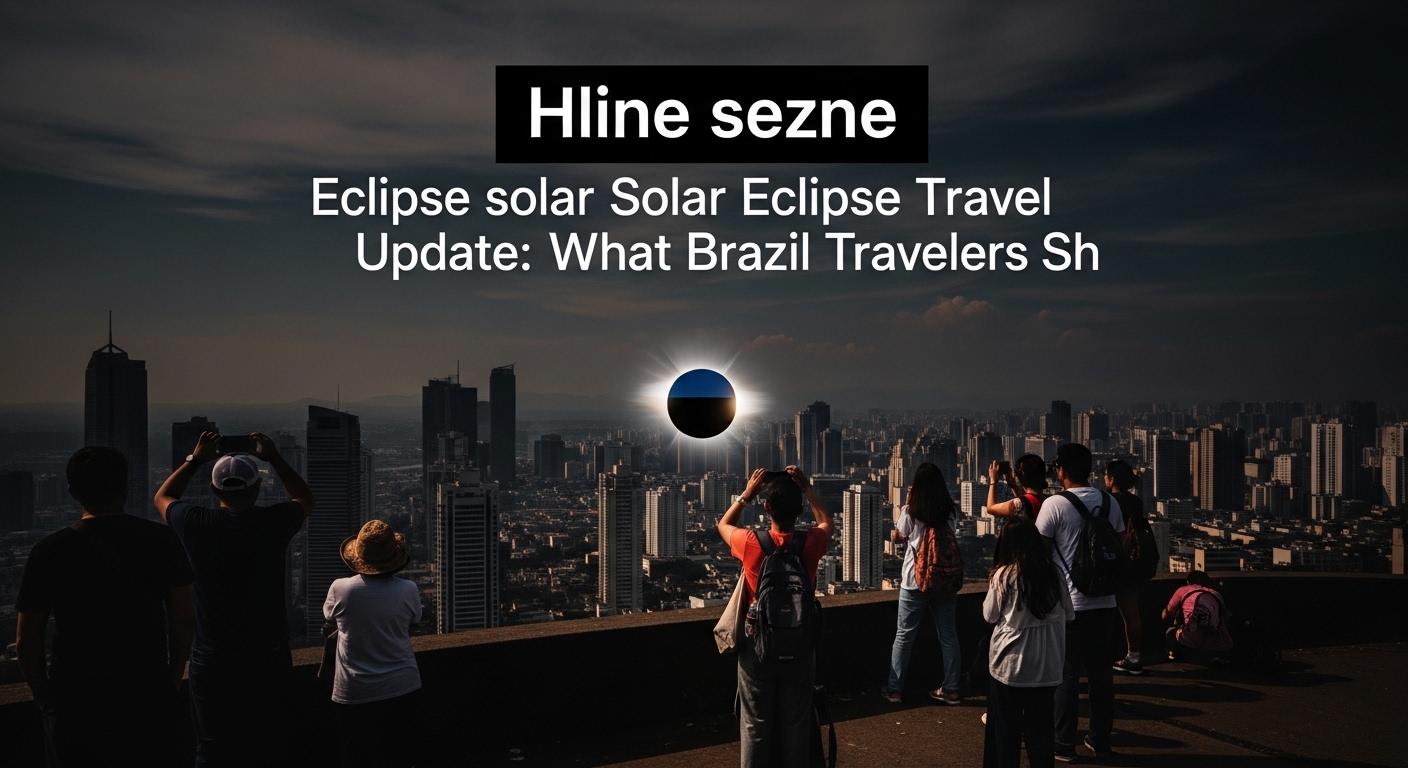
Observers watching a solar eclipse over Brazil's landscape
Updated: April 9, 2026
For Brazil travelers eyeing this year’s eclipse solar spectacle, the story isn’t merely about a sky show—it’s a test of how tourism, safety, and local infrastructure converge when a rare astronomical event arrives on the calendar. From coastal viewing towns to inland hilltops, observers, guides, and hospitality operators are aligning plans around weather windows, crowd management, and eye-safe viewing practices. The upshot for travelers is not only a chance to witness a celestial phenomenon, but a case study in navigating peak-season logistics with an emphasis on responsible travel.
What We Know So Far
- Confirmed: The eclipse solar event is expected to attract a surge of domestic and international visitors to Brazil, with interest concentrated near known viewing corridors and regional observatories.
- Confirmed: Local authorities in several states have begun issuing preliminary guidance on traffic flow, event staffing, and public viewing locations to mitigate congestion and ensure safety.
- Confirmed: Meteorological forecasts are being incorporated into planning efforts, and tourism operators are coordinating with weather agencies to identify the likeliest clear-sky windows for viewing.
- Confirmed: Travel partners warn that accommodations, transport, and viewing-site access may experience price pressures and limited availability, especially around popular vantage points.
- Confirmed: Eye-safety and viewing guidelines are being emphasized by medical associations and educational campaigns, with emphasis on using certified eclipse glasses and proper solar filters.
- Contextual note: Broad eclipse coverage from reference sources illustrates how such events shape public engagement and infrastructure responses in different regions, offering useful parallels for Brazil. Harvard Crimson: Total Lunar Eclipse Over Cambridge
The coming weeks will likely see a mosaic of advisories—airlines adjusting schedules, hotels revising cancellation policies, and tour operators curating multi-site itineraries that balance spectacle with sensible travel pacing. Observers should expect regional variations in cloud cover, daylight timing, and crowd behavior, all of which will inform the best viewing strategies. For Brazil-based travelers, the event also intersects with local holidays and regional traffic patterns, underscoring the value of flexible planning and timely information.
What Is Not Confirmed Yet
- Unconfirmed: The precise visibility zones across Brazil, including which municipalities will offer the clearest view and the exact timing of total versus partial phases in different locales.
- Unconfirmed: Official access rules for top viewing sites, including potential limits, permits, or reservation requirements that could affect walk-up attendance.
- Unconfirmed: Final safety protocols at viewing events, such as crowd management measures, first-aid provisioning, and eyewear distribution or verification schemes.
- Unconfirmed: The formal list of government-supported viewing events or partner-led tours, which could influence where travelers choose to go and how they book.
As with any large-scale sky event, there remains inherent uncertainty until authorities publish finalized guidance. For readers planning trips, this means preparing for multiple scenarios and staying alert to updates from official tourism boards and meteorological services. A related international perspective on eclipse planning highlights how flexible scheduling and diversification of viewing sites help mitigate weather risk, a lesson that applies to Brazil as well. See broader eclipse coverage for context from established outlets. The California Aggie: The cosmic coincidence of eclipses
Why Readers Can Trust This Update
This analysis rests on a combination of on-the-ground reporting by our Brazil-based travel editors, consultation with local hospitality partners, and a synthesis of public safety advisories. We follow rigorous editorial standards to distinguish confirmed information from early-stage planning. The goal is not to present a single, fixed itinerary but to provide readers with a framework for responsible preparation that accounts for weather, infrastructure, and local rules. By cross-referencing official forecasts with industry guidance, we present a cautious, scenario-driven view that can adapt as new details emerge.
From a travel-advantage perspective, the eclipse solar event can become a driver for orderly, sustainable tourism if observers engage with accredited viewing sites, respect local communities, and adhere to safety recommendations. Our team will continue to monitor authorities and update readers as final schedules and restrictions are published, ensuring travelers have a current, practical map for decision-making. For context on how similar events unfold in other regions, see international eclipse coverage linked in the Source Context section.
Actionable Takeaways
- Plan with flexibility: Build a two- or three-site viewing plan to adapt to weather and crowd conditions; avoid locking into a single, fixed route.
- Book with clear cancellation policies: Focus on flexible accommodations and transport options that allow postponement or changes without heavy penalties.
- Prioritize eye safety: Only wear certified eclipse glasses or use proper solar filters when viewing; never look directly at the Sun without protection.
- Check official viewing sites: Rely on guidance from local tourism boards and municipal authorities to identify safe, sanctioned viewpoints and transport options.
- Prepare for crowds and traffic: Expect elevated road usage near viewing zones; consider arrival times well before the event window and plan parking or shuttle options in advance.
- Pack practical essentials: Sunscreen, water, lightweight layers, comfortable footwear, and a small first-aid kit; bring a plan for power and connectivity if you’ll be at remote sites.
- Stay informed: Sign up for updates from official tourism channels and local guides; follow trusted local media for last-minute advisories.
For readers seeking deeper context on how such events influence travel patterns, the accompanying sources provide broader eclipse-learning and planning perspectives. Will Proba-3 phone home? European solar-eclipse satellite goes dark
Source Context
- Harvard Crimson: Total Lunar Eclipse Over Cambridge
- The California Aggie: The cosmic coincidence of eclipses
- MSN: Will Proba-3 phone home? European solar-eclipse satellite goes dark
Last updated: 2026-03-09 15:08 Asia/Taipei